
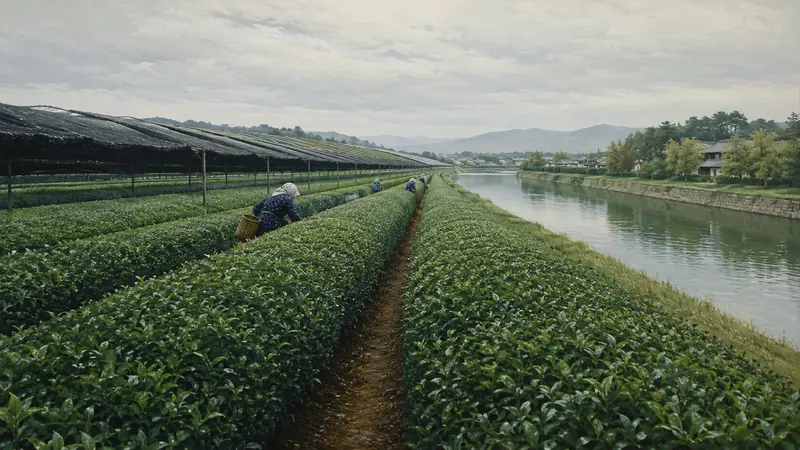
The Uji River leaves Lake Biwa, Japan's largest lake, runs southwest through a narrow valley below Kyoto, and merges with two other rivers to become the Yodo on its way to Osaka Bay. It is not long and it is not dramatic. What it does is hold fog.
Cold water in a tight valley produces morning mist that lingers over the slopes on either bank. Mist diffuses sunlight. Diffused sunlight makes a tea leaf sweeter. Everything Japan is famous for in tea — matcha, gyokuro, the whole aesthetic of umami over astringency — starts from that observation.
How tea reached Uji
Seeds came from China with Buddhist monks in the ninth century, but tea did not really take hold until 1191, when the Zen monk Eisai returned from China with seeds and the Song dynasty method of whisking powdered tea. He wrote Kissa Yōjōki — "Drinking Tea for Health" — and gave seeds to the monk Myōe, who planted them at Tōganoo, northwest of Kyoto.
From there cuttings moved to Uji, and Uji turned out to be better. By the late fourteenth century the shogun Ashikaga Yoshimitsu was personally patronising a group of Uji gardens, and the district's reputation was set. It has not really been challenged in 600 years.

The invention that changed everything: shade
Sometime around the sixteenth century, Uji growers began covering their tea bushes before harvest — first with straw and reed screens (honzu) laid over bamboo frames, today often with synthetic cloth. The plants are shaded for roughly twenty days or more before picking.
The plant responds by changing its chemistry:
- Theanine rises. This amino acid is responsible for the savoury, brothy sweetness the Japanese call umami.
- Catechins fall. Fewer of the compounds that read as bitterness and astringency, because the plant produces them in response to sunlight.
- Chlorophyll rises. The leaf goes a deep, almost fluorescent green as it works harder to capture the light it is being denied.
That single agricultural trick is the difference between an ordinary green tea and gyokuro or matcha. It is also why they are expensive: shading cuts yield substantially and the covering, tending and picking are labour-intensive.
The Uji teas
| Tea | Shaded? | Made from | Character |
|---|---|---|---|
| Matcha | Yes, 20–30+ days | Tencha — shaded leaf, steamed, dried, de-veined, stone-ground | Thick, sweet, intensely umami; whisked, not steeped |
| Gyokuro | Yes, ~20 days | Shaded leaf, rolled like sencha | Deep marine sweetness, low astringency; brewed very cool |
| Sencha | No | Sun-grown leaf, steamed and rolled | Fresh, grassy, brisk; Japan's everyday tea |
| Kabusecha | Partly, ~7–10 days | Briefly shaded leaf | Halfway between sencha and gyokuro |
| Hojicha | No | Roasted sencha or stems | Toasty, caramel, very low caffeine |
| Genmaicha | No | Sencha with roasted rice | Popcorn-sweet, comforting |
Two Uji innovations deserve names attached. In 1738 Nagatani Sōen developed the steamed-and-rolled method that created modern sencha — the tea the vast majority of Japan drinks daily. And in 1835 Yamamoto Kahei is credited with developing gyokuro, the shaded rolled tea that remains the pinnacle of Japanese leaf tea.
Why Japanese green tastes different from Chinese green
One step, applied differently. Both traditions must halt oxidation quickly, but China does it with dry heat in a wok and Japan does it with steam, usually for 15 to 60 seconds.
Steam preserves chlorophyll and the fresh vegetal compounds, giving that vivid green colour and a marine, spinach-and-seaweed profile. Pan-firing caramelises slightly, giving the chestnut and toasted-grain notes of a Longjing. Same plant, same intention, entirely different results.
Matcha, properly
Matcha is not powdered green tea in general — it is stone-ground tencha, made from shaded leaf with the stems and veins removed. Grinding is slow: a traditional granite mill produces something like 30–40 grams an hour, which is a real constraint on supply.
Ceremonial versus culinary is a marketing distinction, not a regulated one, but it points at something true. First-harvest leaf from young plants gives a sweeter, brighter, more vivid powder meant to be drunk with water alone. Later-harvest leaf is more astringent and holds up better against milk and sugar. Paying ceremonial prices to make a latte is a waste; so is trying to drink culinary grade straight.
How to prepare it
- Sift 2 g (about 1 heaped chashaku scoop) into a warmed bowl.
- Add 60–70 ml water at 70–80 °C. Never boiling.
- Whisk briskly in a W or M motion with a chasen for 15–20 seconds, until a fine even foam forms.
- Drink within a minute or two — matcha separates as it stands.
How to brew gyokuro
Gyokuro is the most counter-intuitive brew in tea: 50–60 °C / 120–140 °F, a large amount of leaf (4 g to 60 ml), and a full two minutes. The result is a tiny quantity of almost syrupy, savoury liquid closer to broth than to tea. It is a genuinely strange and wonderful thing, and boiling water destroys it instantly.
Small country, outsized influence
Japan produces around 74,000 tonnes of tea a year — about one percent of world output, and a rounding error next to Assam alone. Uji is a small fraction of that. But global demand for matcha has risen steeply in recent years, and the supply of properly shaded, stone-ground first-harvest tencha simply cannot expand quickly. The shading, the twenty days, the granite mill — none of it scales.
Which is, in the end, the point.
Frequently asked questions
Why is Uji famous for tea?
Uji has grown tea since the thirteenth century and received shogunal patronage from the late fourteenth century. Its river valley traps morning fog that naturally diffuses sunlight, and Uji growers pioneered deliberate shading of tea plants, the technique behind matcha and gyokuro. It remains Japan's most prestigious tea district.
What is the difference between matcha and gyokuro?
Both are made from shaded tea leaves, but matcha is made from tencha — shaded leaf that is steamed, dried, de-veined and stone-ground into powder, then whisked into water and consumed whole. Gyokuro is shaded leaf that is rolled like sencha and steeped, then strained out.
Why is tea shaded before harvest in Japan?
Shading for around 20 days before picking raises theanine (which gives savoury umami sweetness), lowers catechins (which cause bitterness and astringency), and increases chlorophyll, deepening the green colour. It substantially reduces yield, which is why shaded teas cost more.
What temperature should matcha be prepared at?
70–80 °C (160–175 °F). Boiling water scorches matcha and makes it bitter. Use about 2 g of sifted powder to 60–70 ml of water and whisk briskly with a bamboo chasen until an even fine foam forms.
What is the difference between Japanese and Chinese green tea?
Japanese green tea is steamed to halt oxidation, which preserves chlorophyll and produces vivid green, marine, umami flavours. Chinese green tea is usually pan-fired in a hot wok, which adds toasty, chestnut and nutty notes. The plant is the same; the fixing method differs.
What is the difference between ceremonial and culinary matcha?
It is a marketing distinction rather than a regulated grade, but it reflects a real difference. Ceremonial-style matcha comes from first-harvest young leaf and is sweeter and brighter, intended to be drunk with water alone. Culinary matcha comes from later harvests, is more astringent, and stands up better in lattes and baking.
