
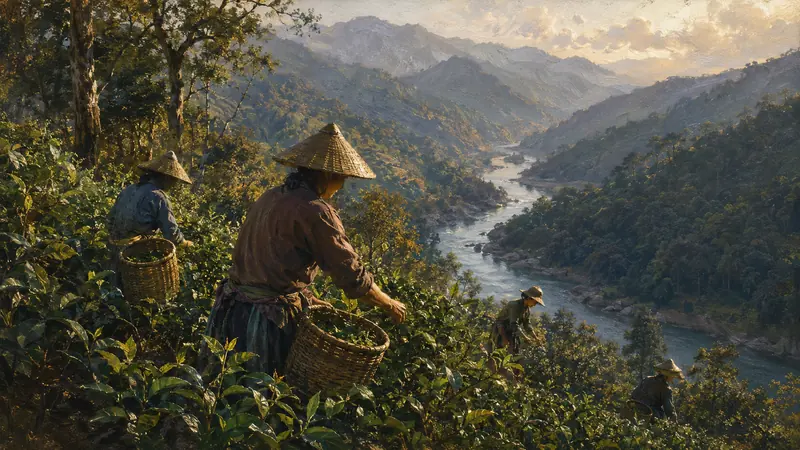
The Mekong is the twelfth longest river in the world and it passes through six countries, but tea people care about one stretch of it. In China it is the Lancang Jiang — the Lancang — and it cuts north to south through Yunnan, straight down the middle of the region where the tea plant was first domesticated.
If tea has a birthplace, this is the address.
A river that divides the tea mountains
Yunnan's classical tea geography is defined by the Lancang itself. The historic Six Famous Tea Mountains — Yiwu, Yibang, Gedeng, Mangzhi, Manzhuan and Youle — lie east of the river, in the area traditionally called Jiangnei, "inside the river." A later group of celebrated mountains — Bulang, Nannuo, Jingmai, Bada, Mengsong and the Menghai area including Lao Banzhang — lie to the west, Jiangwai, "outside the river."
That is not a poetic framing invented by marketers. It is how the region has organised itself for centuries: the river is the reference line against which every tea mountain is located.

Ancient trees, not bushes
Most of the world's tea grows on waist-high bushes kept clipped flat for machine or hand picking. Yunnan is different. Here the plant is Camellia sinensis var. assamica, the broad-leaf tropical variety, and in the old gardens it is allowed to grow as a tree.
Some are genuinely ancient. Gushu — "old tree" — generally refers to plants of at least a century, and the oldest cultivated specimens are considerably older than that. Their roots reach deep into mineral subsoil, they grow in mixed forest rather than monoculture, and they yield tiny quantities of intensely flavoured leaf. Gushu material commands staggering prices and is, unsurprisingly, the most fraudulently labelled category in tea.
The Tea Horse Road
Yunnan tea travelled long before it was fashionable. From the Tang dynasty onward, compressed tea moved north and west along the Chamagudao — the Ancient Tea Horse Road — over some of the most difficult terrain on the continent, into Tibet. Tibetans, whose diet was short on vegetables, needed tea. The Chinese court needed cavalry horses. The two traded for roughly a thousand years.
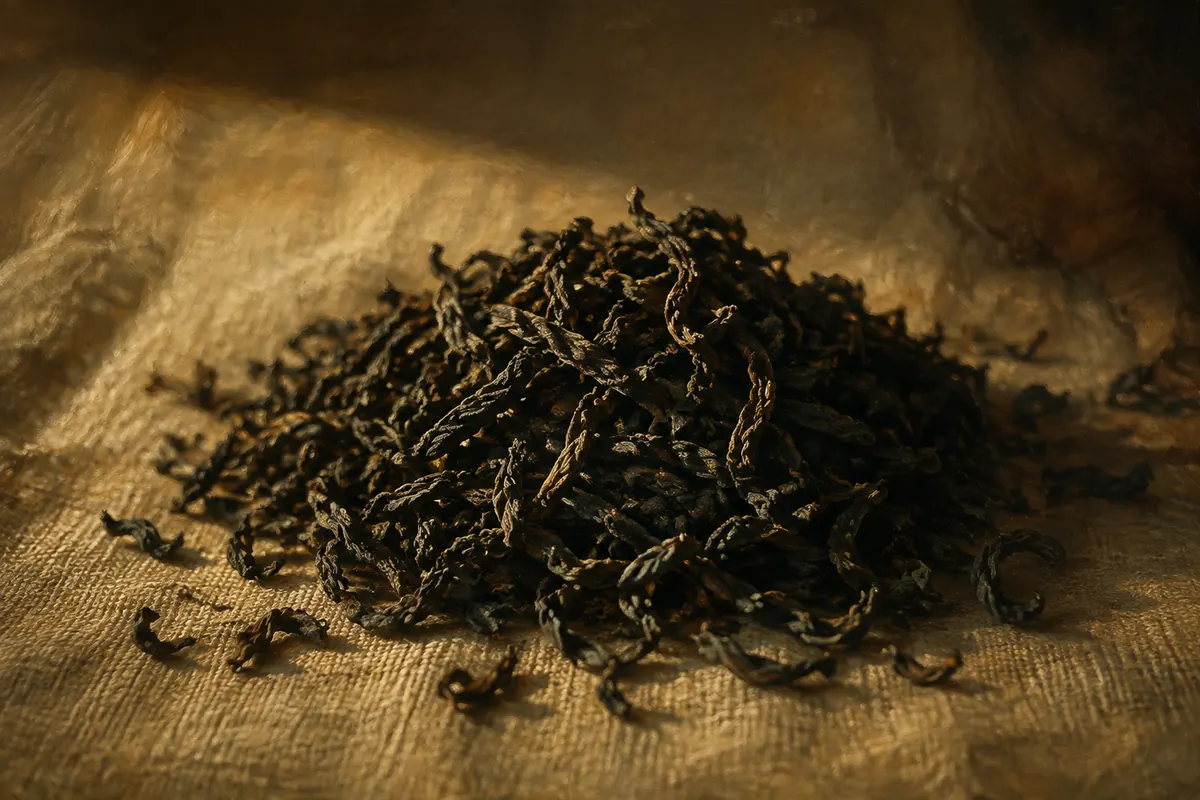
Compression was the practical answer to that journey: pressing loose leaf into dense cakes and bricks made it possible to load onto mules. But months of humidity, altitude and temperature swing did something nobody planned. The tea changed. It got smoother, darker, sweeter. What began as packaging became the defining characteristic of the category.
Sheng and shou: the two pu-erhs
Pu-erh is the one true post-fermented tea most people will encounter, and it exists in two quite different forms.
| Sheng (raw / 生) | Shou (ripe / 熟) | |
|---|---|---|
| Method | Pressed young, aged naturally over years | Accelerated fermentation by controlled wet-piling (wò duī) |
| Invented | Centuries old | 1973 |
| Young taste | Bitter, astringent, floral, vivid | Smooth, earthy, ready immediately |
| Aged taste | Deep, sweet, camphor, dried fruit, woodsy | Mellows further; less transformation |
| Timeline | 10–30+ years to hit its stride | Drinkable in months |
| Buy it if | You want a tea that is a vintage | You want depth without the wait |
Shou pu-erh deserves its own note. In 1973 Yunnan producers developed wò duī — wet piling — in which damp leaf is heaped, covered and turned under careful microbial control for weeks. It compresses something like thirty years of natural ageing into about two months. Purists were sniffy about it for decades; it is now roughly half the market and some of it is excellent.
Reading a pu-erh cake
Compressed forms are part of the language:
- Bingcha — the classic round disc, standardly 357 g, historically seven to a bamboo-wrapped tong.
- Tuocha — a small dome or bowl shape, from 100 g down to single-serving nuggets.
- Zhuancha — a rectangular brick, the traditional caravan format.
What to look for on the wrapper: the production year, the region or mountain, the factory or producer, and whether it is sheng or shou. What to be suspicious of: no year, no producer, and the word "ancient."
How to brew pu-erh
Pu-erh is nearly impossible to over-brew, which makes it a forgiving tea to learn on.
- Break, don't crumble. Use a pu-erh pick to lever flakes off the cake along the leaf layers. Powdered leaf brews muddy.
- Rinse. Cover the leaf with boiling water for 5–10 seconds and pour it away. This wakes the compressed leaf and washes off storage dust.
- Water: full boil, 100 °C / 212 °F.
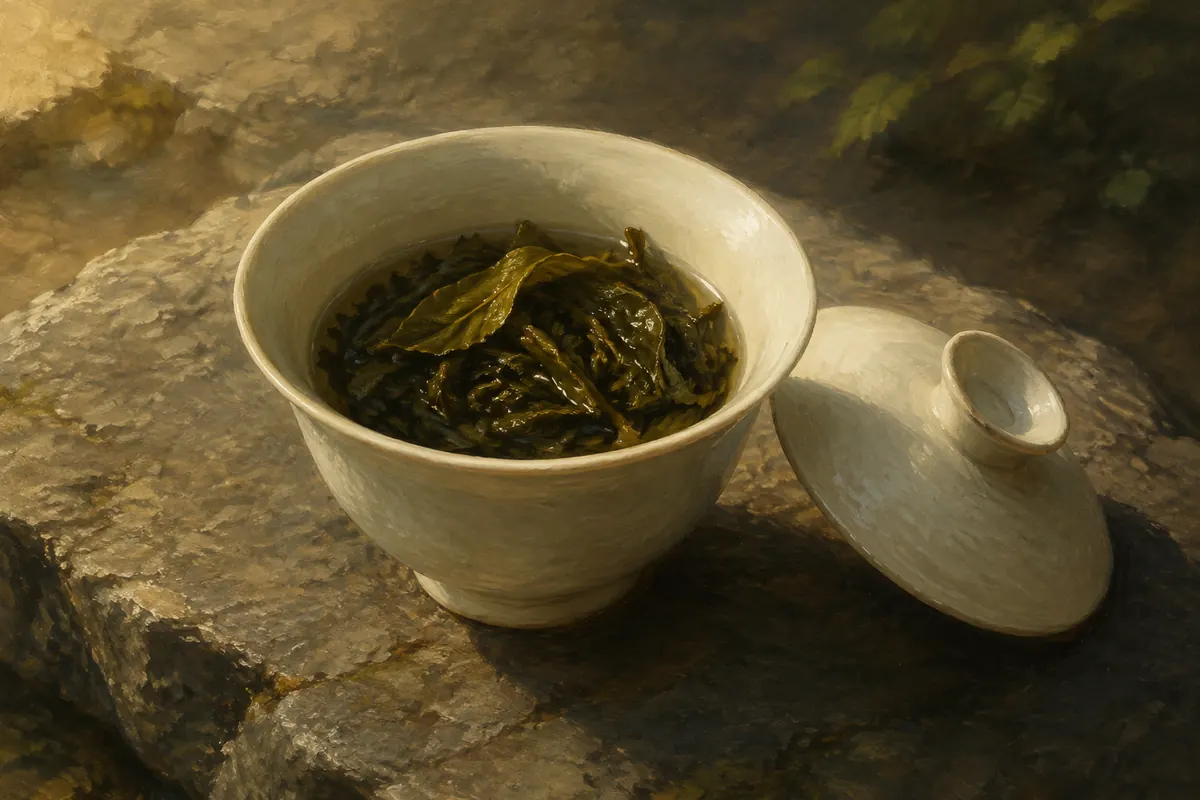
- Gongfu: 6–8 g per 100 ml, infusions of 10–20 seconds to start, extending as it goes. Good pu-erh gives ten or more distinct infusions.
- Western: 4 g per 300 ml, 3 minutes, re-steep freely.
Storing it
Pu-erh is the only tea you are supposed to keep. It wants stable warmth, moderate humidity, airflow and no strong smells — not a sealed jar and not a fridge. Kept properly, a raw cake will still be changing in twenty years. Kept in a kitchen cupboard next to the spices, it will taste like the spices.

Why the Mekong basin still matters
Yunnan is where the plant came from, where compression was invented, where the caravan trade ran, and where the world's only genuinely age-worthy tea is still made. Everything else in this journal — Assam, Uji, Ceylon, Kenya — descends, botanically or culturally, from this river's forests.
Frequently asked questions
What is pu-erh tea?
Pu-erh is a post-fermented dark tea from Yunnan province, China, made from the broad-leaf Camellia sinensis var. assamica. Unlike other teas, it undergoes genuine microbial fermentation and is usually compressed into cakes, bricks or domes. It is the only major tea category that improves with long ageing.
What is the difference between sheng and shou pu-erh?
Sheng (raw) pu-erh is pressed young and ages naturally over decades, starting bright and astringent and becoming deep and sweet. Shou (ripe) pu-erh uses a controlled wet-piling fermentation called wò duī, invented in 1973, to produce a smooth, earthy tea that is drinkable straight away.
How is the Mekong river connected to pu-erh tea?
The Mekong is known as the Lancang in China and runs north to south through Yunnan, the birthplace of tea. Yunnan's classical tea mountains are traditionally grouped by their position relative to the river — the historic Six Famous Tea Mountains lie east of it, and a later celebrated group lies to the west.
Does pu-erh tea really get better with age?
Raw (sheng) pu-erh genuinely does, given proper storage — stable warmth, moderate humidity, airflow and no strong odours. It typically needs 10 to 30 years to reach its best. Ripe (shou) pu-erh mellows with age but changes far less, because most of the fermentation has already been done.
What is the Tea Horse Road?
The Chamagudao, or Ancient Tea Horse Road, was a network of caravan routes that carried compressed Yunnan tea over the mountains into Tibet in exchange for horses, from roughly the Tang dynasty onward. The long, humid journey caused the tea to ferment and mellow — which is how pu-erh's defining character was discovered.
How do you brew pu-erh tea?
Break flakes from the cake along the leaf layers, rinse them with boiling water for 5–10 seconds and discard that water, then infuse with fully boiling water. Gongfu style, use 6–8 g per 100 ml with short infusions of 10–20 seconds, extending gradually. Good pu-erh yields ten or more infusions.
