
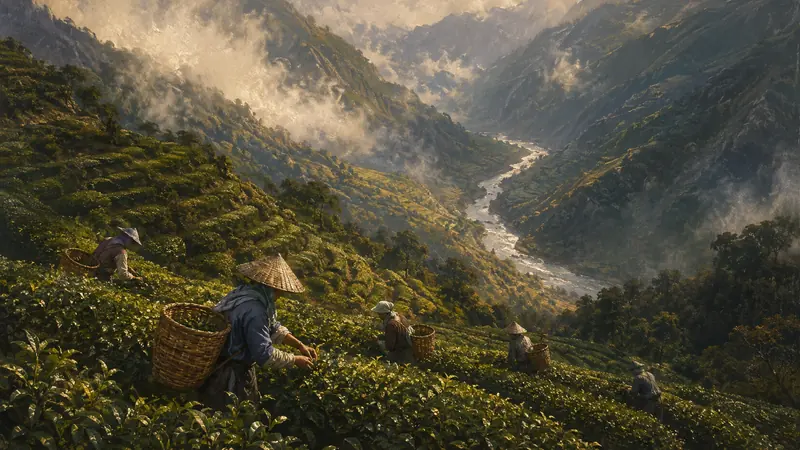
The Teesta begins in the glacial lakes of north Sikkim and falls fast — from over 5,000 metres to the plains in a little more than 400 kilometres. On its way it carves the valley that separates the Darjeeling hills from Sikkim, meets the Rangeet at Triveni, and eventually joins the Brahmaputra in Bangladesh.
The tea grown on the ridges above it is the most famous, most imitated and most precarious in the world.
Why altitude changes everything
Darjeeling's gardens sit between roughly 600 and 2,000 metres. At that elevation the tea plant grows slowly — cold nights, thin air, persistent mist rolling up from the Teesta gorge. A bush that would flush every seven days in the Assam heat takes far longer here.
Slow growth concentrates flavour. The leaves stay small, the yields stay low, and the aromatic compounds accumulate rather than being diluted by rapid vegetative growth. The result is a black tea unlike any other — pale in the cup, light in body, and extraordinarily aromatic. It behaves more like a fine white wine than like the robust teas grown on the plains below.
The other decisive factor is the plant itself. Where Assam grows the broad-leaf assamica, Darjeeling was planted mainly with Chinese Camellia sinensis var. sinensis — small-leaf, cold-tolerant, and floral by nature.

A doctor's experiment, 1841
Darjeeling became a tea district almost casually. Archibald Campbell, a surgeon serving as superintendent of the newly acquired hill station, planted Chinese tea seed in his garden at Beechwood in 1841, mostly to see what would happen. It flourished. Commercial planting followed within a decade, and by the 1870s the hills were covered.
The Darjeeling Himalayan Railway — the "toy train," a UNESCO World Heritage Site since 1999 — was built to move that tea, and the people who bought it, up the ridge.
The four flushes
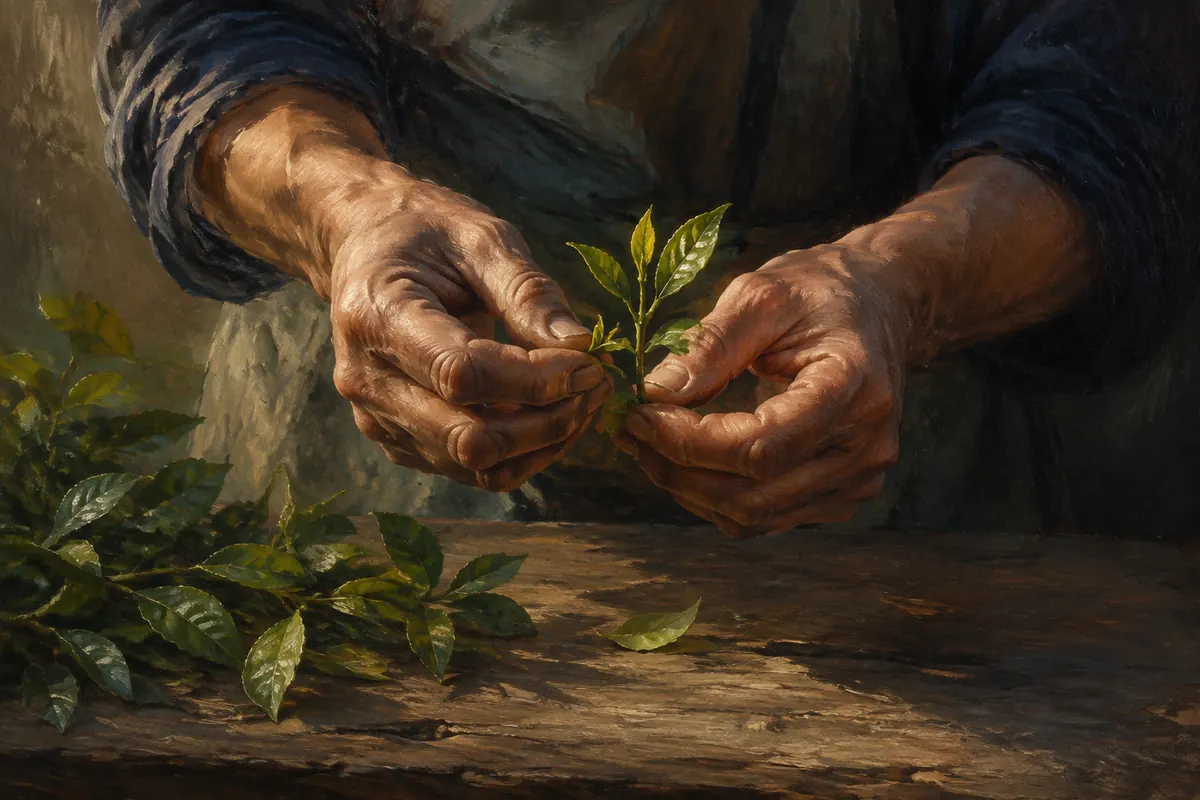
Nowhere is the harvest calendar more consequential than here. Darjeeling is effectively four different teas.
| Flush | Timing | Liquor | Character |
|---|---|---|---|
| First flush | Mid-March – April | Pale gold-green | Brisk, green, floral, almost grassy; high astringency |
| Second flush | May – June | Amber | Muscatel — ripe grape, apricot, honey, rounded |
| Monsoon flush | July – September | Darker | Strong, plain, used mostly for blending |
| Autumn flush | October – November | Coppery | Soft, nutty, gently spiced; underrated |
The strange origin of muscatel
Muscatel — that ripe-grape note that makes second flush Darjeeling famous — is not really a product of soil or altitude. It is a wound response.
In the early summer, tiny green leafhoppers (Empoasca species, known locally as jassids) feed on the young leaves. The plant reacts to the damage by producing defensive aromatic compounds. Tea makers, rather than fighting the insects, learned to harvest exactly when the bugs have been at work. The same phenomenon produces the honeyed character of Taiwan's Oriental Beauty oolong.
Small production, enormous name
Darjeeling's scale is the thing most people get wrong. The district produced about 5.71 million kilograms in 2024 — roughly what Assam turns out in a few days. Output has been falling for decades: 14.49 million kg in 1990, and the first eleven months of 2025 came in at 5.19 million kg, down almost 9% year on year.
The pressures are stacked: ageing bushes planted generations ago, a difficult labour market, increasingly erratic monsoons, and cheap competition from just across the border in Nepal's Ilam district, where the growing conditions are nearly identical and the costs are lower.
Meanwhile, far more tea is sold worldwide as "Darjeeling" than Darjeeling has ever produced. That gap is why the protection matters.
What the GI actually means
In 2004–05 Darjeeling tea became India's first registered Geographical Indication, and in 2011 it won protected status in the European Union. Under those rules, only tea grown and processed in the defined Darjeeling district may carry the name, and genuine product is certified and traceable to a registered garden.
Practically, for a buyer: insist on a named estate, a stated flush and a harvest year. A tin labelled only "Darjeeling" tells you almost nothing.
How to brew Darjeeling
- Water: 90–95 °C / 195–205 °F — not a rolling boil, especially for first flush.
- Leaf: 2.5 g per 200 ml, and let it have room; the leaf is large and needs to unfurl.
- Time: 2–3 minutes for first flush, 3–4 for second.
- Milk: no. Milk erases everything you paid for.
Darjeeling is also one of the few black teas that rewards a second infusion. Push the time to four or five minutes on the second pour.
Is it worth the money?
A good second flush from a named Darjeeling garden is genuinely singular — there is no substitute for muscatel, and no other region reliably produces it. Whether it is worth several times the price of an excellent orthodox Assam depends entirely on whether you want power or perfume. Buy one of each and decide honestly.
Frequently asked questions
Why is Darjeeling called the champagne of teas?
The comparison reflects both its aromatic, wine-like character and its protected origin. Darjeeling is grown only in a defined Himalayan district, produced in small quantities, and priced accordingly — and like champagne it is legally protected, having become India's first Geographical Indication in 2004–05.
What is muscatel flavour in Darjeeling tea?
Muscatel is the ripe-grape, apricot and honey note found in second flush Darjeeling. It is caused by tiny leafhopper insects feeding on the young leaves; the plant responds by producing defensive aromatic compounds, which the tea maker then captures by harvesting at exactly the right moment.
What is the best flush of Darjeeling tea?
Second flush, harvested in May and June, is the most prized because it carries the muscatel character. First flush is lighter, greener and more astringent and has its own devoted following. Autumn flush is softer and often good value.
How much Darjeeling tea is actually produced?
About 5.71 million kilograms in 2024 — down from 14.49 million kg in 1990. Production continues to fall due to ageing tea bushes, labour shortages, erratic weather and competition from neighbouring Nepal. Far more tea is sold worldwide under the Darjeeling name than the district actually grows.
Should you put milk in Darjeeling tea?
No. Darjeeling is light-bodied and prized for delicate floral and muscatel aromatics, all of which are masked by milk. Drink it plain, at slightly below boiling temperature.
