
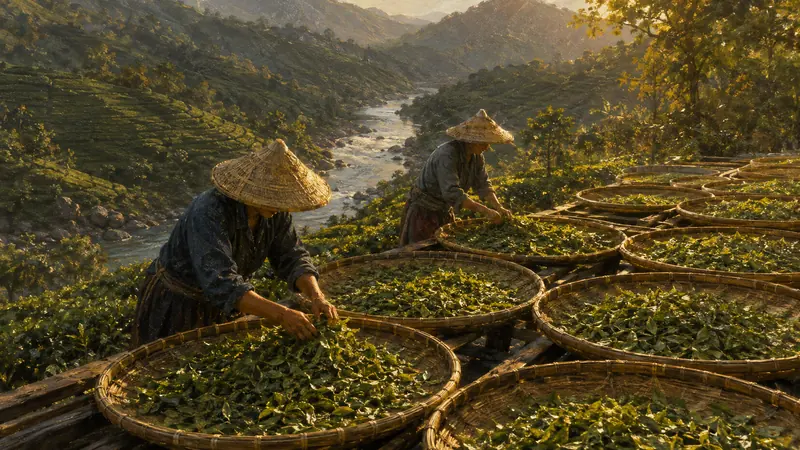
There are six types of tea, and one plant. White, green, yellow, oolong, black and dark tea are all made from Camellia sinensis. What separates them is oxidation — how far the leaf is allowed to react with air before the maker stops the process with heat.
Everything that gets called "herbal tea" — chamomile, rooibos, peppermint, hibiscus — contains no tea at all. Those are tisanes. They are worth drinking; they are just a different subject.
The one variable that matters: oxidation
Break a leaf and it starts to brown, the same way a cut apple does. Enzymes in the leaf react with oxygen, and the chemistry of the leaf changes: fresh, grassy compounds convert into progressively deeper malty, fruity and woody ones. Tea making is the craft of controlling that reaction and then stopping it exactly where you want it.
Heat kills the enzymes and freezes the flavour in place. In China this step is called shāqīng — "kill green." Apply it immediately and you get green tea. Apply it after several hours of careful bruising and you get oolong. Skip it, let the leaf oxidise fully, then dry it, and you get black tea.
| Type | Oxidation | Typical flavour | Classic examples |
|---|---|---|---|
| White | Minimal (natural, ~5%) | Delicate, hay, melon, honey | Silver Needle, White Peony |
| Green | None (halted immediately) | Grassy, chestnut, marine, sweet | Longjing, Sencha, Gyokuro |
| Yellow | None + slow smothering | Green tea without the edge; mellow, corn-sweet | Junshan Yinzhen, Huoshan Huangya |
| Oolong | Partial (10–80%) | Floral to roasted; orchid, stone fruit, caramel | Tieguanyin, Da Hong Pao, Dong Ding |
| Black | Full (~100%) | Malty, brisk, fruity, tannic | Assam, Darjeeling, Ceylon, Keemun |
| Dark | Post-fermented by microbes | Earthy, woody, mushroom, sweet depth | Pu-erh (sheng & shou), Liu Bao |

White tea
The least processed of all. Buds and young leaves are picked, withered in air — often in sun and shade in turn — and dried. There is no rolling, no pan-firing, no deliberate bruising. A small amount of oxidation happens naturally during the long wither, which is why white tea is not identical to green tea despite both being pale in the cup.
The best-known style, Silver Needle (Baihao Yinzhen), is made of unopened buds only, each covered in fine silver down. White tea is expensive because the picking standard is brutal: a kilo of finished tea takes a great many buds and a very short window.
Brew: 80–85 °C / 175–185 °F, 3–5 minutes, generous leaf. It forgives long steeps better than most people expect.
Green tea
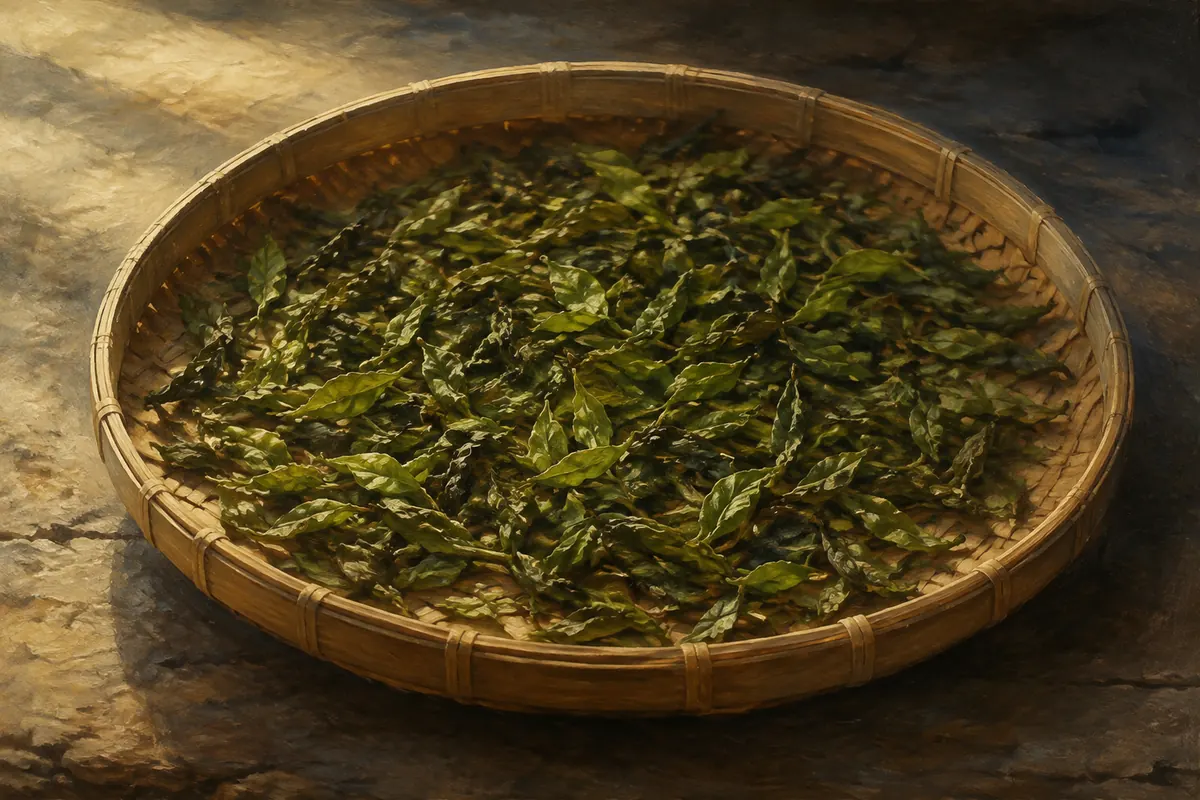
Oxidation is stopped almost immediately after picking, which preserves the leaf's fresh character. How it is stopped defines the two great families.
Pan-fired (Chinese) — the leaf meets a hot dry wok. This adds a toasty, nutty, chestnut note. Longjing from Hangzhou is the archetype, pressed flat by hand against the wok wall.
Steamed (Japanese) — the leaf is steamed for seconds. This keeps a vivid green colour and a marine, umami, seaweed-and-spinach profile. Sencha, gyokuro and matcha from Uji are the reference points.
Brew: 70–80 °C / 160–175 °F, 1–3 minutes. Boiling water is the single most common way people ruin good green tea — it scalds the leaf and pulls harsh tannins.
Yellow tea
The rarest of the six and the one most drinkers never meet. Yellow tea is made like green tea, then given an extra step: the warm, still-damp leaves are wrapped or piled and left to "smother" (mèn huāng) for hours or days. A gentle non-enzymatic yellowing occurs, stripping out the grassy sharpness and leaving something rounder and sweeter.
It is labour-intensive, commercially marginal, and produced in tiny quantities — which is exactly why it is worth trying when you find it.
Oolong
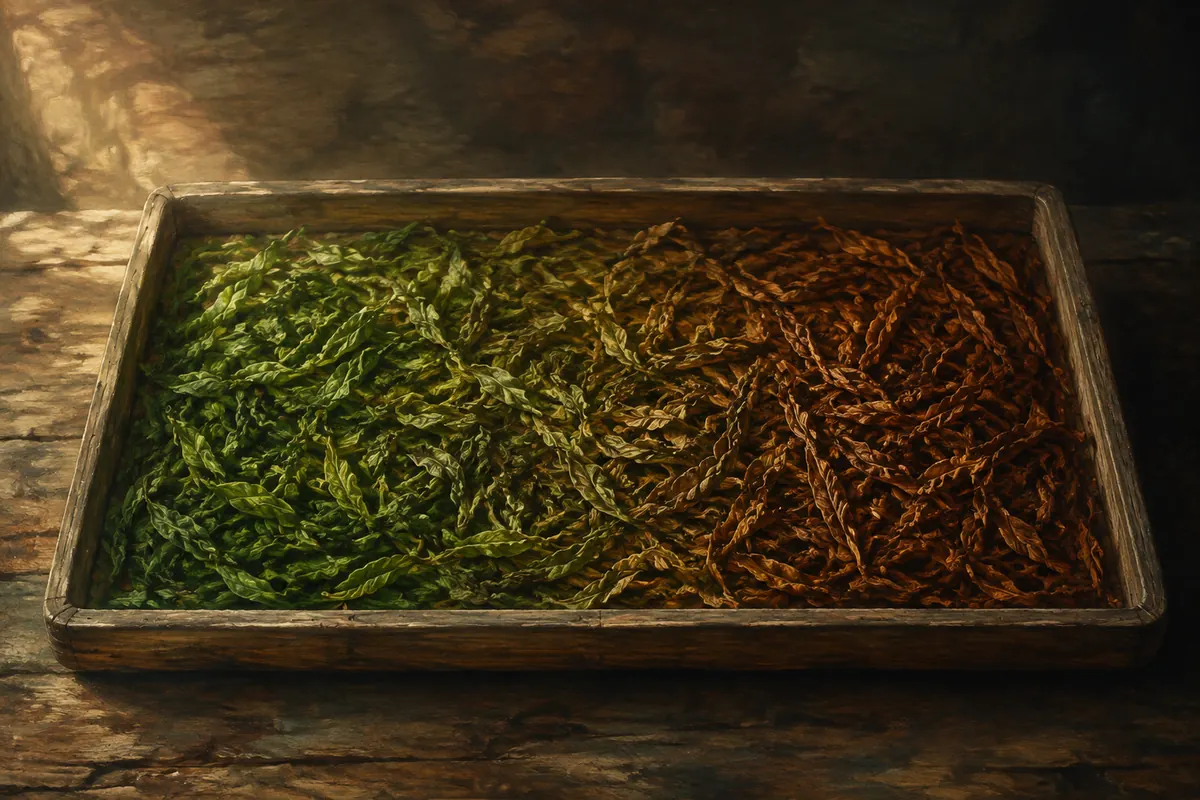
The most technically demanding category and the widest in range. Oolong is partially oxidised, anywhere from around 10% to 80%, through repeated cycles of withering, shaking and bruising the leaf edges, resting, then firing. Some are then roasted, sometimes over years.
The result is not one flavour but a spectrum:
- Lightly oxidised, unroasted — green-jade rolled balls, intensely floral, lilac and orchid. Taiwanese high-mountain oolongs and modern Tieguanyin.
- Heavily oxidised or roasted — dark twisted leaf, stone fruit, honey, caramel, toasted grain. Wuyi rock oolongs like Da Hong Pao; traditional Dong Ding.
Oolong rewards gongfu brewing: a lot of leaf, a small vessel, and many short infusions that each taste different.
Brew: 90–95 °C / 195–205 °F. Western style, 3–4 minutes. Gongfu style, 5–7 grams per 100 ml, 20–40 second infusions, eight or more rounds.
Black tea
Called hong cha — red tea — in China, for the colour of the liquor rather than the leaf. The leaf is withered, rolled hard to rupture its cells, oxidised fully until it turns coppery, then fired dry. This is the tea that built the global trade, because full oxidation makes it stable enough to survive months in a ship's hold.
Origin matters enormously here:
- Assam — malty, thick, brisk; the backbone of breakfast blends and the tea that takes milk best.
- Darjeeling — light-bodied, floral, with the muscatel grape note of a good second flush. Usually drunk without milk.
- Ceylon — bright, citrusy and clean, with character that shifts sharply by elevation.
- Kenyan — brisk, coppery, full-bodied; mostly CTC and the engine of the world's tea bags.
Brew: 95–100 °C / 205–212 °F, 3–5 minutes. Assam and Ceylon take milk; Darjeeling generally should not.
Dark tea (including pu-erh)
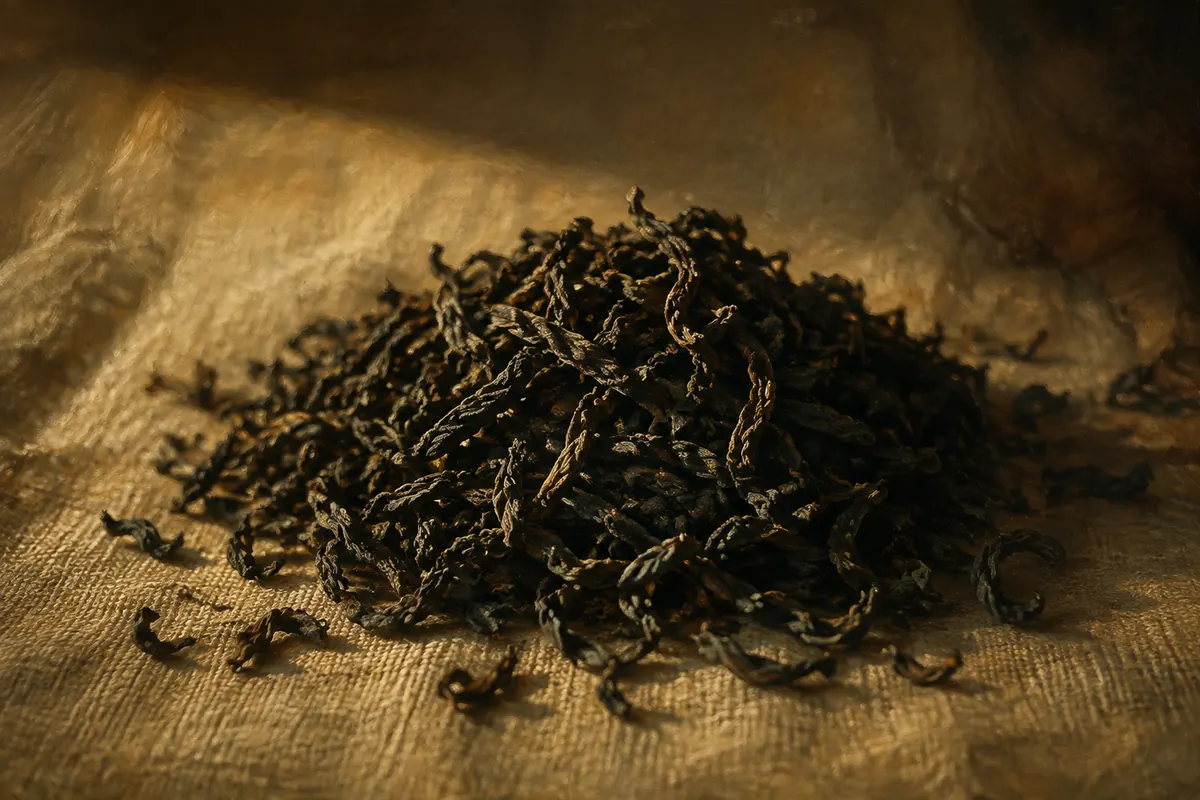
The only category defined by genuine fermentation — microbial action, not enzymatic oxidation. Finished tea is exposed to controlled humidity and allowed to change over months, years or decades under the influence of bacteria and fungi.
Pu-erh from Yunnan is the famous example, and it splits in two:
- Sheng (raw) — pressed young and aged slowly and naturally. Starts bright, bitter and astringent; over 10–30 years becomes deep, sweet and complex. It is the only tea that is genuinely a vintage product.
- Shou (ripe) — developed in 1973 to imitate decades of ageing in weeks, via a controlled wet-piling process called wò duī. Smooth, earthy, ready immediately.
Brew: boiling water. Rinse the leaf once for 5–10 seconds and discard, then infuse. Dark teas take many infusions and are difficult to over-brew.
Which type should you start with?
If you drink coffee and want something with body, start with a single-estate Assam or a Kenyan black. If you find black tea harsh, start with a lightly oxidised oolong — it is the most immediately likeable category for most people. If you want to understand what tea people mean by terroir, buy a Darjeeling second flush and a pre-Qingming Longjing and drink them a day apart.
Frequently asked questions
What are the six types of tea?
The six types are white, green, yellow, oolong, black and dark tea (which includes pu-erh). All six are made from the leaves of Camellia sinensis. They differ by how much the leaf is oxidised before the process is halted with heat.
What is the difference between green tea and black tea?
Green tea is heated almost immediately after picking to stop oxidation, preserving fresh, grassy and vegetal flavours. Black tea is rolled and allowed to oxidise fully before drying, which develops malty, fruity and tannic flavours and a darker liquor. Both come from the same plant.
Is herbal tea real tea?
No. Chamomile, peppermint, rooibos, hibiscus and similar infusions contain no Camellia sinensis and are correctly called tisanes or herbal infusions. Only the six types made from the tea plant are true tea.
Which tea has the most caffeine?
There is no reliable rule by colour. Caffeine content depends mainly on the tea plant variety, the age of the leaf picked, the proportion of buds, whether the plant was shaded, and brewing time and temperature. A shaded Japanese gyokuro often contains more caffeine than many black teas.
What water temperature should I use for tea?
Roughly: green tea 70–80 °C, white tea 80–85 °C, oolong 90–95 °C, black tea and dark tea 95–100 °C. Using boiling water on green or white tea is the most common cause of bitterness.
What is pu-erh tea?
Pu-erh is a dark tea from Yunnan, China, that undergoes genuine microbial fermentation rather than just oxidation. Raw (sheng) pu-erh ages naturally over decades; ripe (shou) pu-erh uses a controlled wet-piling process invented in 1973 to achieve a similar mellow, earthy character quickly.
